Food Imperialism

The global food system is often sold to us as a triumph of modern efficiency. We’re told that industrial farming and global trade are the only ways to feed a growing population. But if the system is so efficient, why do hundreds of millions of people still go hungry while record amounts of food are wasted?

To find the answer, we have to look at the power dynamics of food imperialism.

An extended version of this essay was first published by The New Climate in December 2024
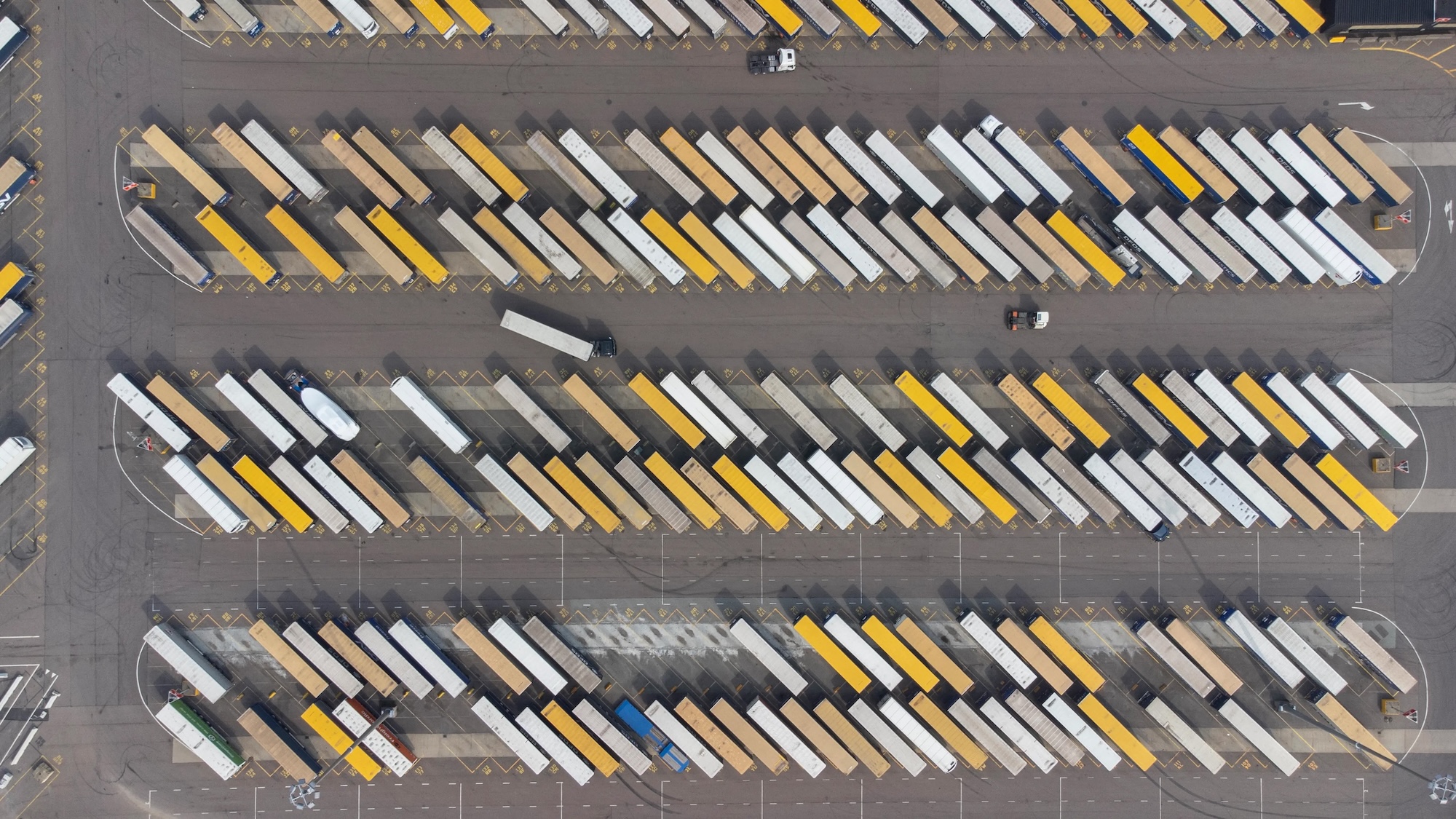
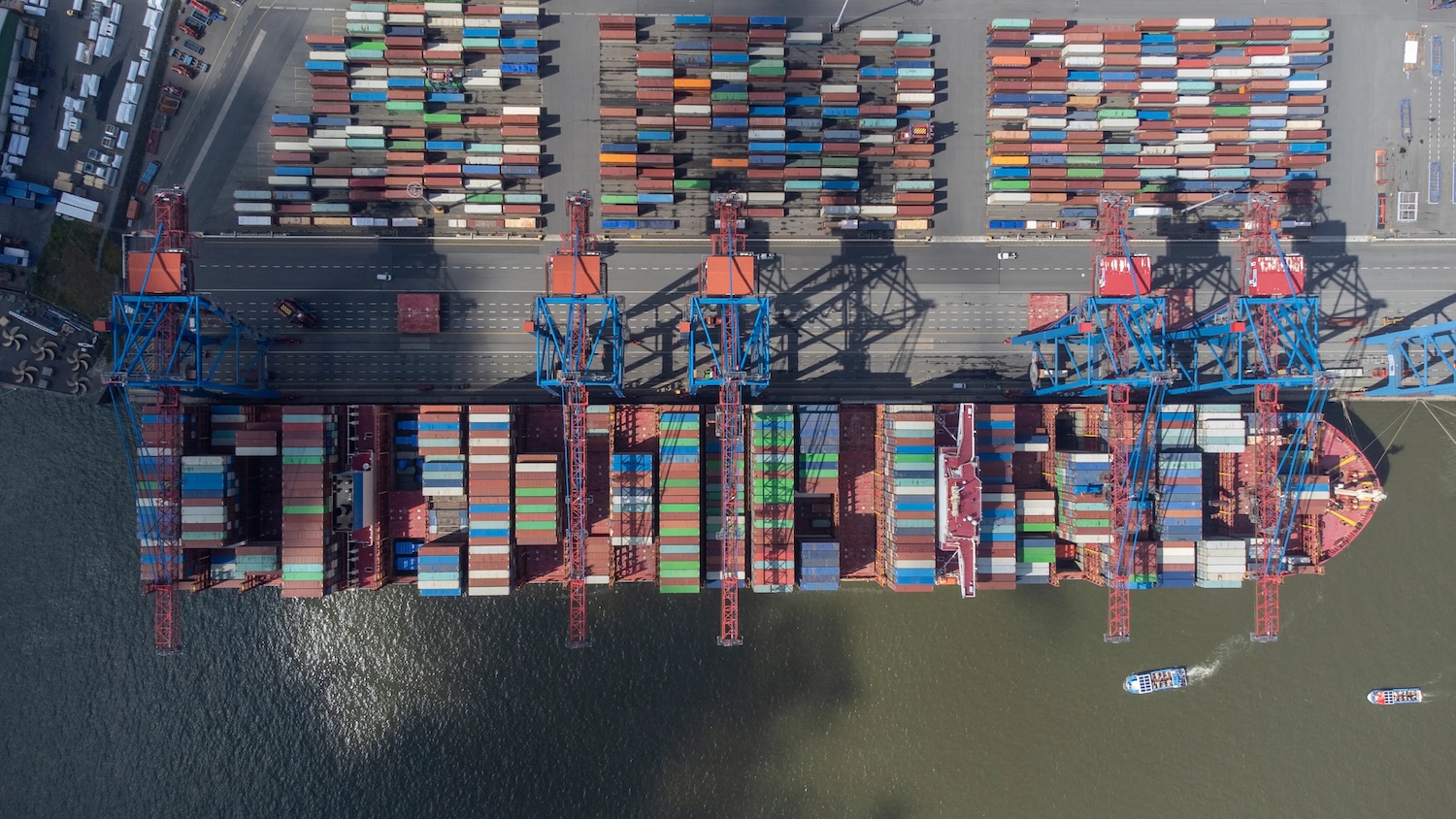
Shipping containers wait to be loaded onto cargo ships at Gothenburg’s port
What is Food Imperialism?

In simple terms, food imperialism is a system where wealthy nations and massive corporations control the land, labour, and resources of poorer countries.

While the era of traditional empires might seem like history, the structures they built are still very much alive. Today, instead of direct colonial rule, control is maintained through unfair trade deals, debt, and a global market that treats food as a financial investment rather than a human right.

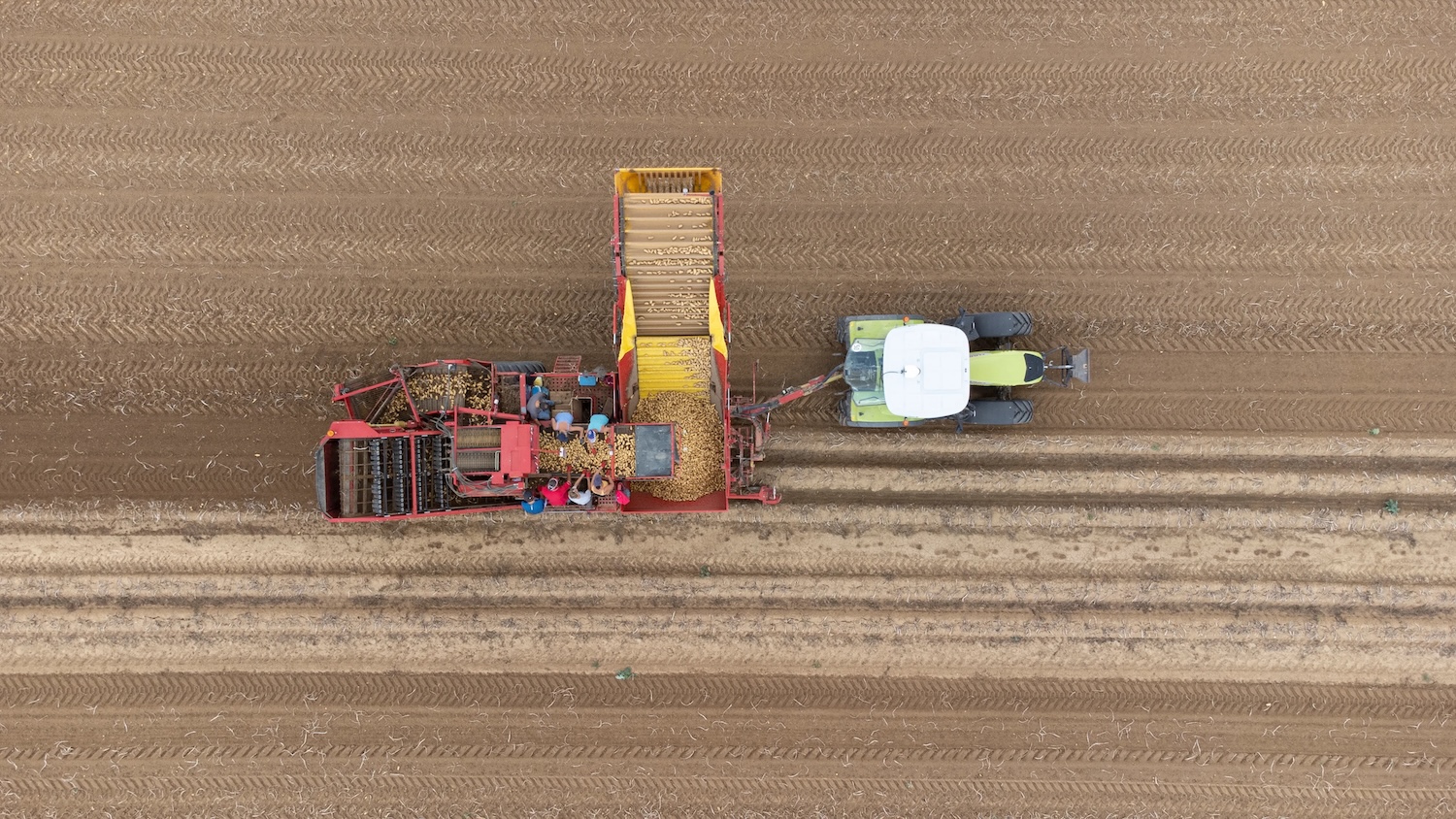
Farm workers in France sort potatoes as they are harvested

How the System is Rigged

The way we produce and trade food today is designed to move wealth from the Global South to the Global North. This happens in a few key ways:

  • The Cash Crop Trap : Many developing nations are pressured to use their best land to grow crops for export—like coffee, cocoa, or soy for animal feed—rather than growing staples like grains or vegetables to feed their own people.
  • Market Dumping : Wealthy countries often subsidise their own industrial mega-farms and then "dump" the surplus on international markets at prices lower than the cost of production. This makes it impossible for local farmers in poorer nations to compete, destroying local economies and making those countries dependent on imports.
  • Corporate Monopolies : A tiny number of giant corporations now own the patents for the world’s seeds and chemicals. This creates a cycle of dependency where farmers must buy new seeds and expensive fertilisers every year, often falling into lifelong debt.

A cargo ship being loaded up at Gothenburg port

The Real Cost

This isn't just about economics; it’s about health and the environment. As traditional, diverse diets are replaced by cheap, ultra-processed imports, many communities face a "double burden" of malnutrition—suffering from both hunger and rising rates of diet-related illnesses like diabetes.

Environmentally, the drive for "cheap" food leads to massive deforestation and soil exhaustion. These ecological costs are effectively outsourced to the poorest parts of the world so that supermarket prices in the West stay artificially low.

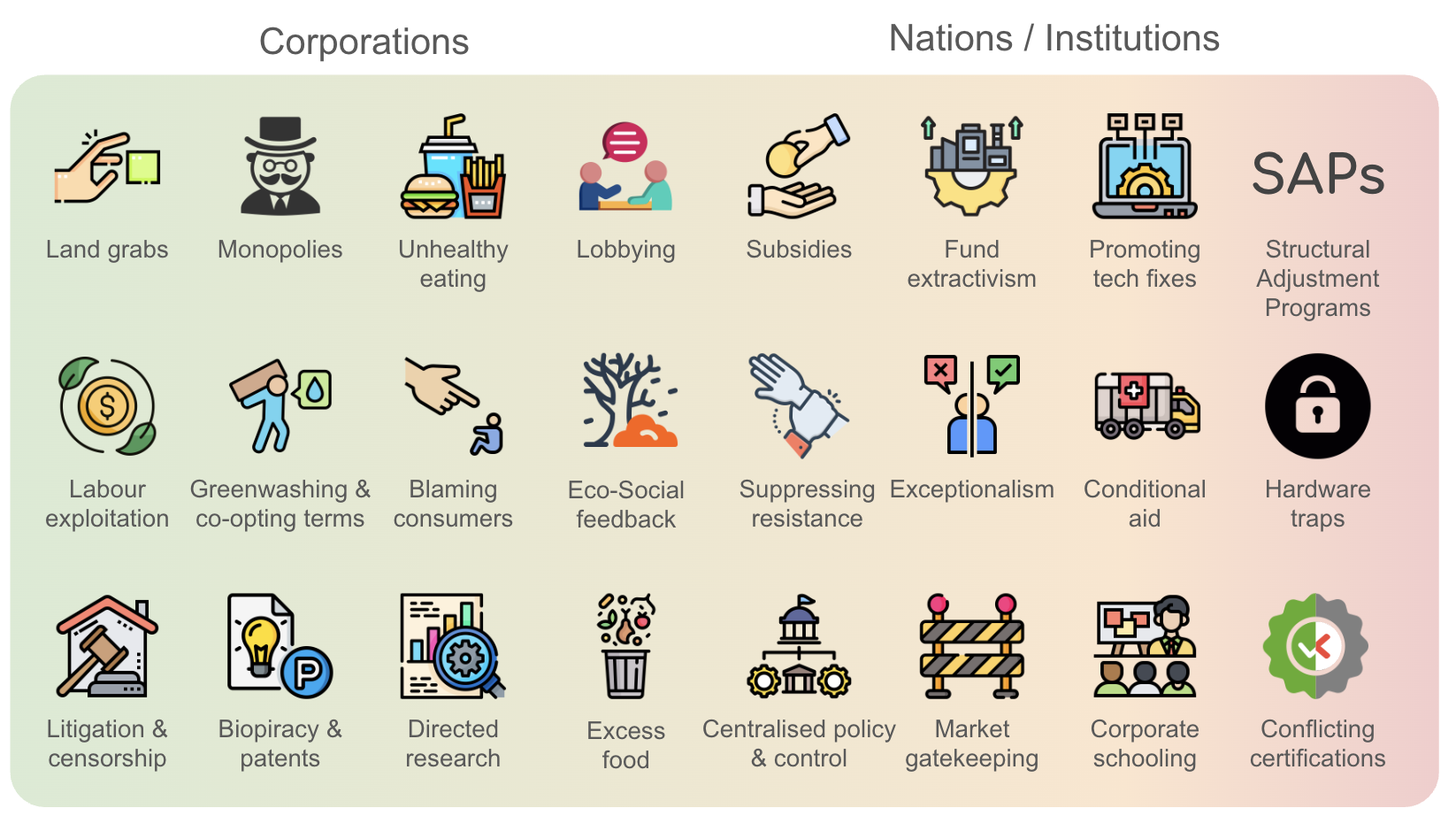
To help identify how these power dynamics work in practice, we can use a framework called The Food Imperialist’s Playbook. This is a vital tool for spotting the specific 'plays' used to gain control over other societies through their food systems.

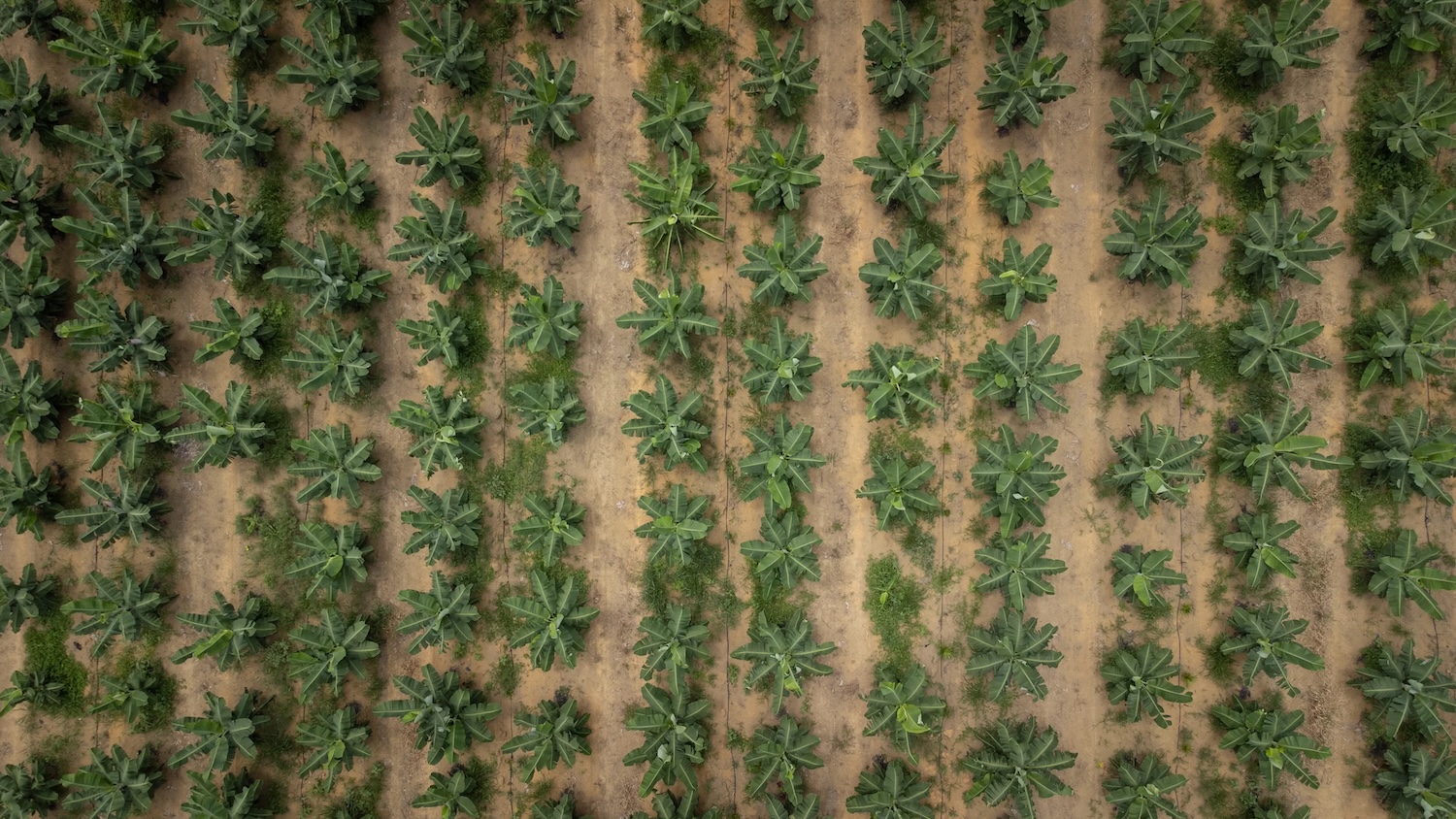
A banana plantation monocrop in Bahia state, Brazil

The Food Imperialist’s Playbook

Understanding food imperialism can sometimes feel overwhelming because the tactics are often hidden behind complex trade jargon or economic policies. The Playbook simplifies this by breaking down the strategies used to create dependency.

Think of it as a set of recurring patterns—specific moves designed to shift power away from local communities and into the hands of global monopolies. By using this framework, we can see that what looks like a series of disconnected market trends is actually a co-ordinated system of control.

The Food Imperialist’s Playbook illustrates how specific "plays"—from seed monopolies to market dumping—work together to dismantle local food sovereignty and create global dependency. This framework helps us identify the systemic patterns used to control societies through their dinner plates.

1. Strategic Financial & Structural Controls

Focus: The high-level institutional mechanisms that force nations into the imperialist system

  • Structural Adjustment Programs: Forcing economic shifts through debt
  • Subsidies: Using Global Minority wealth to distort global markets
  • Conditional aid: Tying assistance to the adoption of specific imperialist agendas
  • Lobbying: Influencing policy at the source of power for corporate/national/institutional gain
  • Centralised policy & control: Consolidating decision-making power away from the local level

2. Material Extraction & Market Dominance

Focus: The physical and economic "taking" from the Global Majority.

  • Land grabs: The physical seizure of territory for intensive food production and profit extraction
  • Fund extractivism: Providing financial backing for intensive resource extraction
  • Monopolies: Market consolidation to eliminate competition
  • Labour exploitation: Extracting value from underpaid or forced labour
  • Eco-Social Feedback: The outsourcing of environmental and social costs back onto the extracted territory
  • Unhealthy eating: Replacing local diets with commodity-driven processed foods

3. Technical & Epistemic Lock-ins

Focus: The "invisible" plays that control the future of agriculture through tech and law.

  • Patents: Claiming ownership of life and seeds
  • Promoting tech fixes: Pushing capital-intensive technological solutions
  • Funding research: Directing science toward imperialist goals
  • System lockins: Creating infrastructure that makes alternatives impossible to implement
  • Blocking alternatives: Actively suppressing non-imperialist systems
  • Extension services: Training farmers to rely on proprietary inputs/technology
  • Conflicting certifications: Confusion caused by certification systems that appear not to align

4. Narrative & Defensive Plays

Focus: Managing dissent and perception to protect the status quo.

  • Exceptionalism: Promoting the idea that this system is superior or the only way
  • Greenwashing: Using ecological language to hide extraction
  • Blaming consumers: Reframing systemic failures as individual choices
  • Supressing resistance: Silencing movements that challenge the plays/players
  • Litigation & censorship: Using legal and informational power to suppress data or critics

Using the Playbook allows us to look at a new trade deal, a seed patent law, or a massive land purchase and ask: Which play is being made here? It is useful for several reasons:

  • Spotting the Pattern: It helps us recognise that the struggle of a farmer in India or a consumer in Ghana is often driven by the same 'plays' used by the same handful of global entities.
  • Predicting the Outcome: When we see these tactics being deployed, we can predict the likely impact on local health, biodiversity, and economic independence.
  • Targeting the Resistance: Once we identify the specific play—whether it is 'Market Dumping' or 'The Cash Crop Trap'—we can better understand how to dismantle it and advocate for genuine food sovereignty.

By learning to recognise these plays, we can move from being passive consumers to informed advocates, helping to challenge a system that continues to prize corporate expansion over human dignity.

Tomatoes lie rotting in a field next to a greenhouse—discarded because irrigation costs rose too high

Moving Toward Food Sovereignty

The solution isn't just sending more food aid, which often just supports the corporations that created the problem. Instead, we need to support food sovereignty: the right of people to define their own food and agriculture systems.

This means breaking up corporate monopolies, ending trade rules that penalise small-scale farmers, and prioritising feeding people over producing biofuels or cheap livestock feed.

Building a fairer system starts with acknowledging that the current crisis isn't a lack of food—it’s a lack of justice. By dismantling these imperialist structures, we can create a world where everyone has a seat at the table.

A migrant labourer house (a chabola) outside a greenhouse in Almería—the utlimate result of food imperialism